
Layered intrusions are stratified igneous bodies, typically of basaltic composition. They result from impressive mantle-derived magmatic activity and are of outstanding economic importance, as they hold some of the world’s largest reserves of strategic elements, including Ni, Cr, V and the platinum-group elements (PGE). Despite their petrological and economic significance, however, the petrogenesis of magmatic layering and the processes controlling associated mineralisation is still a matter of debate.
Our research focuses on fundamental questions such as: 1) how igneous layering forms, including the mechanisms of layer accumulation and subsequent modification by late- and post-magmatic processes. 2) Understanding the mineralisation of magmatic layers - particularly PGE-enriched sulphides - and their relation to the aforementioned processes. 3) The cooling history of layered intrusions, with the aim of constraining the timescales of crystallization and solidification of magmatic layers. To address these questions, we investigate the petrography, texture, mineral chemistry and geochemistry of chromitite and magnetite seam - layers composed predominately of chromite and magnetite, respectively - in several layered intrusions. These include the Bushveld Complex – the largest known intrusion on Earth, the Rum Layered Intrusion, NW Scotland, and the Stillwater Complex, USA.
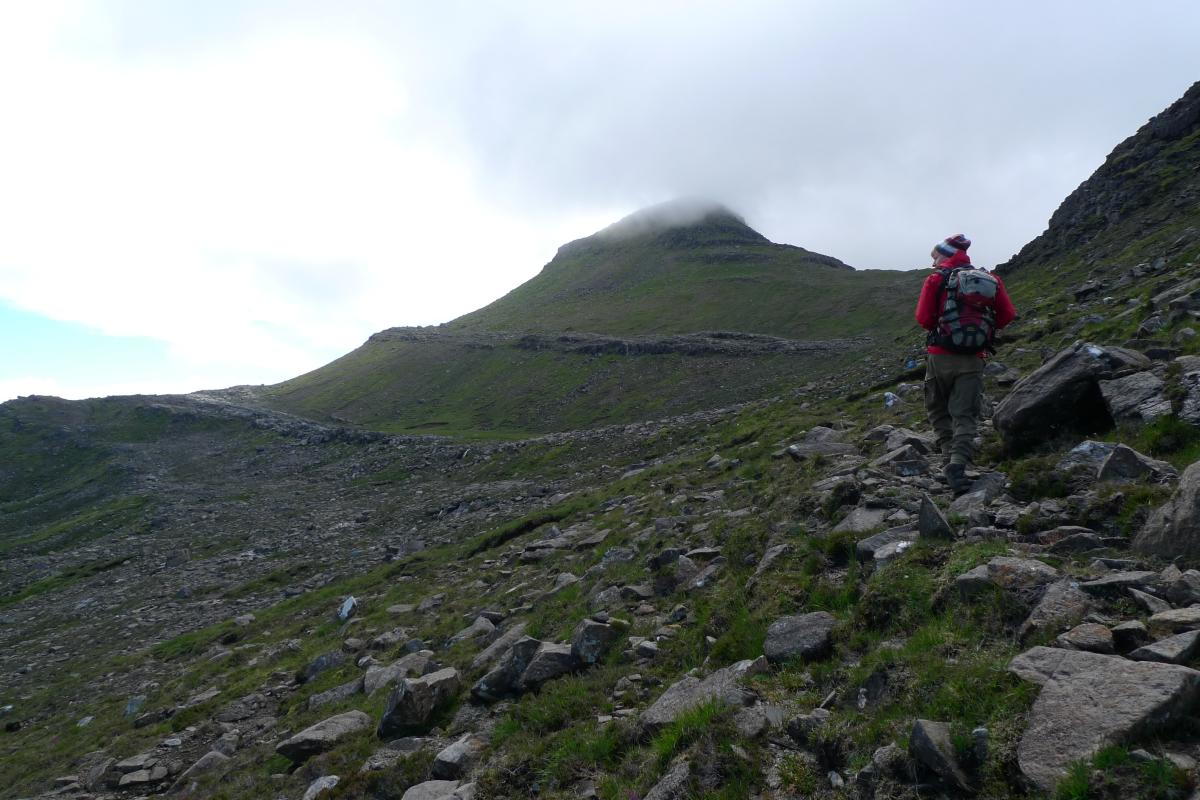
Photo: Layering of the Rum Layered Intrusion, Isle of Rum, L. Hecht
Selected publications
- Latypov, R., Chistyakova, S., Kaufman, F.E.D., Roelofse, F., Kruger, W., Barnes, S. J., Magson J. and Nicholson, M. (2023). The use of An-content of interstitial plagioclase for testing slurry models for the origin of Bushveld massive chromitites. Lithos, 460. doi: https://doi.org/10.1016/j.lithos.2023.107374
- Zhou, H., Trumbull, R.B., Veksler, I.V., Bindeman, I.N., Glodny, J. Kaufmann, F.E.D., Rammlmair, D. Contamination of the Bushveld Complex (South Africa) magmas by basinal brines: Stable isotopes in phlogopite from the UG2 chromitite. Geology 49 (11), doi: https://doi.org/10.1130/G49173.1
- Kaufmann, F.E.D., O’Driscoll, B. and Hecht, L. (2019). Lateral variations in the Unit 7–8 boundary zone of the Rum Eastern Layered Intrusion, NW Scotland: implications for the origin and timing of Cr-spinel seam formation. Contributions to Mineralogy and Petrology, 173 (90), doi: https://doi.org/10.1007/s00410-020-01732-x
- Kaufmann, F.E.D., Hoffmann, M.C., Bachmann, K., Veksler, I.V., Trumbull, R.B. and Hecht, L. (2019). Variations in Composition, Texture, and Platinum Group Element Mineralization in the Lower Group and Middle Group Chromitites of the Northwestern Bushveld Complex, South Africa. Economic Geology, 114 (3), 569–590. doi: https://doi.org/10.5382/econgeo.4641
- Kaufmann, F., Vukmanovic, Z., Holness, M.B., Hecht, L. (2018). Orthopyroxene oikocrysts in the MG1 chromitite layer of the Bushveld Complex: Implications for cumulate formation and recrystallisation. Contributions to Mineralogy and Petrology, 173 (17), doi: https://doi.org/10.1007/s00410-018-1441-x