
Impacts of cosmic projectiles on Earth create characteristic shock wave effects in rocks, which can be used to verify the impact and determine the pressure in the affected rock. The mineral quartz, which is commonly found in the Earth's upper crust, exhibits particularly typical effects.
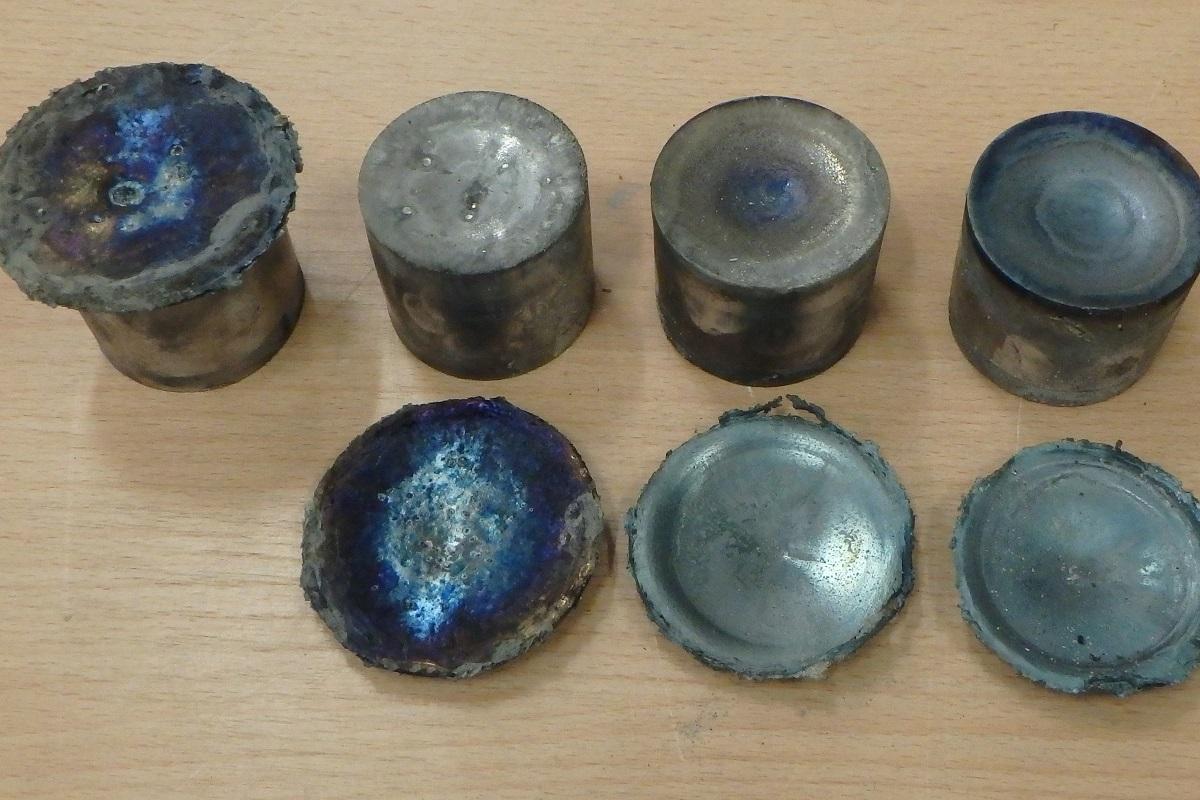
In this subproject, “Microscale shock wave processes in sandstone,” the shock wave metamorphism of sandstone was investigated using high-explosive experiments conducted at the Fraunhofer Ernst Mach Institute. The experimental setup replicates on a small scale what happens when an asteroid strikes the Earth's upper crust. The experimental setup, or more precisely, the “shock recovery experiments”, provided comparative material for the classification of naturally shock-deformed rocks.
In non-porous, quartz-rich rocks such as granite, impacts of approx. 10 GPa or more cause the formation of so-called planar deformation features (PDFs). These are amorphous defects that form regularly in the crystal structure of the quartz grains. At higher shock wave intensities and pressures, so-called diaplectic glasses (i.e., material that has been amorphized in the solid state and was not liquid, unlike glass solidified from a melt) and, in some cases, coesite, a high-pressure modification of quartz, form from quartz at pressures of approx. 35 GPa and above. At even higher pressures, from approx. 55-60 GPa, the quartz melts and glass solidified from the melt is formed.
In porous quartz-rich rocks, such as sandstone, the typical planar deformation features (PDFs) hardly occur, especially in the case of small impacts (crater diameter less than 2 km). Therefore, it was difficult to reliably identify small impact craters, such as those found in the Sahara, based on such shock wave effects. The examination of sandstone samples from a total of 20 shock recovery experiments provided important data for classifying the traces in the rock. In the project, thin sections of the deformed sample material approx. 25 micrometers thick were prepared and structurally characterized using light and electron microscopes and a Raman spectrometer.
The evaluation largely confirmed the researchers' expectations. As knowledge of traces in natural craters suggested, the typical planar deformation features (PDFs) were hardly observed in the experiments either. The shock wave pressure is distributed very irregular within the rock, which means that even at comparatively low pressures, porous quartz rocks partially melt. The laboratory results help to identify impact craters on Earth and estimate the pressure on their rocks.
It was particularly interesting that the high-pressure mineral stishovite was sporadically discovered in sandstone subjected to low shock wave pressure. Transmission electron microscopy played an important role in this discovery and has contributed significantly to our understanding of the formation of this high-pressure mineral in impact rocks.
project title: MEMIN I, TP VII: Low grade shock metamorphism of quartz in porous and wet sedimentary rocks
Funding: Deutsche Forschungsgemeinschaft (DFG)
Duration: 2009 – 2016
Selected Publications:
- Ebert, M., Kowitz, A., Schmitt, R. T., Reimold, W. U., Mansfeld, U. and Langenhorst, F. 2018. Localized shock induced melting of sandstone at low impact pressures (<17.5 GPa): An experimental study. Meteoritics and Planetary Science 53(8), 1633-1643. DOI: 10.1111/maps.12948
- Mansfeld, U., Langenhorst, F., Ebert, M., Kowitz, A. and Schmitt, R. T. 2017. Microscopic evidence of stishovite generated in low-pressure shock experiments on porous sandstone: constrains on its genesis. Meteoritics and Planetary Science 52(7), 1449-1464. DOI: 10.1111/maps.12867
- Kowitz, A., Güldemeister, N., Schmitt, R. T., Reimold, W. U., Wünnemann, K. and Holzwarth, A. 2016. Revision of existing shock classifications for quartzose rocks using low shock pressure recovery experiments (2.5-20 GPa) and meso-scale numerical modeling. Meteoritics and Planetary Science, 51(10), 1741-1761. DOI: 10.1111/maps.12712
- Buhl, E., Kowitz, A., Elbeshausen, D., Sommer, F., Dresen, G., Poelchau, M. H., Reimold, W. U., Schmitt, R. T. and Kenkmann, T. 2013. Particle size distribution and strain rate attenuation in hypervelocity impact and shock recovery experiments. Journal of Structural Geology 56, 20-33. DOI: 10.1016/j.jsg.2013.08.007
- Kowitz, A., Schmitt, R. T., Reimold, W. U. and Hornemann, U. 2013. The first MEMIN shock recovery experiments at low shock pressure (5-12.5 GPa) with dry, porous sandstone. Meteoritics and Planetary Science 48, 99-114. DOI: 10.1111/maps.12030.
- Kowitz, A., Güldemeister, N., Reimold, W. U., Schmitt, R. T. and Wünnemann, K. 2013. Diaplectic quartz glass and SiO2 melt experimentally generated at only 5 GPa shock pressure in porous sandstone: Laboratory observations and meso-scale numerical modeling. Earth and Planetary Science 384, 17-26. DOI: 10.1016/j.epsl.2013.09.021