This subproject focused on the chemical-physical interaction between the “projectile” (the impacting asteroid) and the “target” (the planetary surface the projectile strikes) during hypervelocity impact events. Using a combination of hypervelocity impact experiments, innovative laser experiments, and petrological investigations of natural impactites from terrestrial impact structures, we were able to gain a better understanding of the chemical and physical processes involved in the formation of so-called impact melts and condensates..
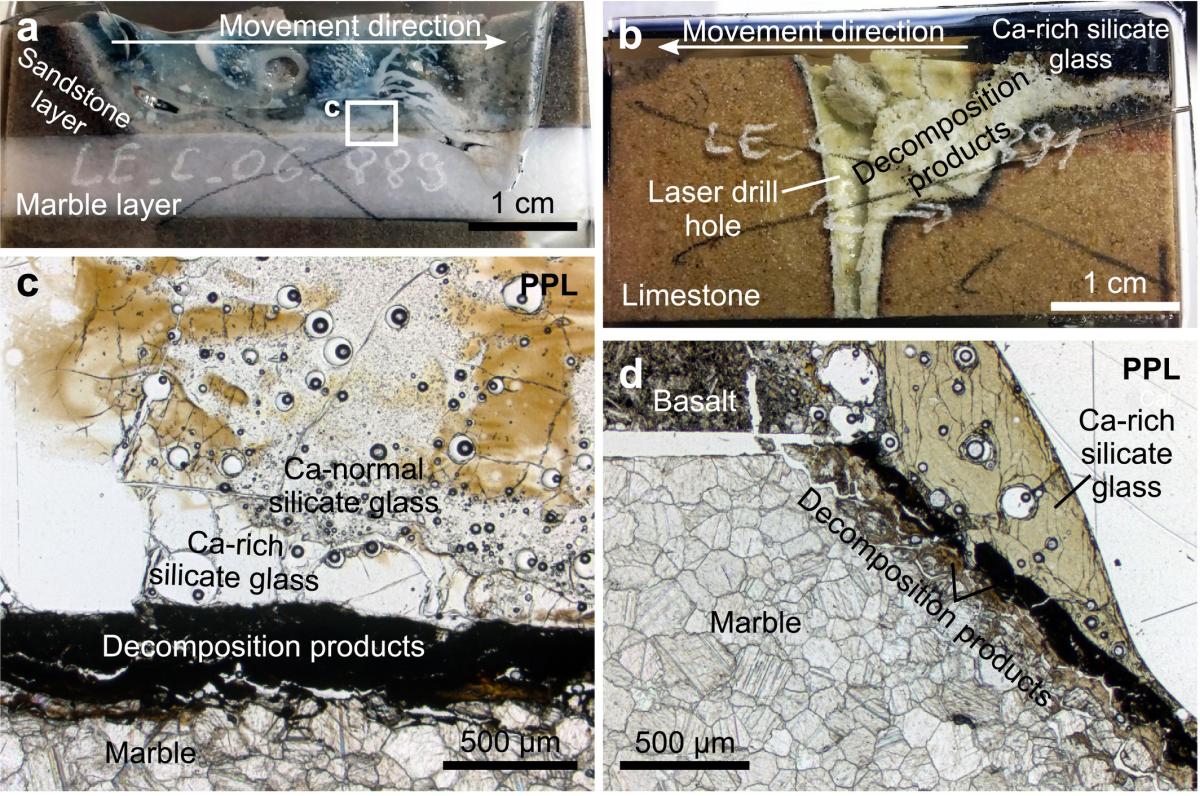
While the chemical-physical interaction of silicate rocks and metallic impactors was the main focus of the first funding phase of MEMIN, the second funding phase of this subproject focused on the reaction of carbonates to extreme pressure and temperature conditions during the decompression phase of impact events. A key finding of the second funding phase of this subproject is that carbonates decompose extremely quickly (seconds to tens of seconds) and efficiently when they come into contact with silicate impact melts, leading to the release of CO2 and the enrichment of the silicate melt with CaO (and MgO in the case of dolomite-bearing target rocks). The observed interface processes resemble skarn-forming reactions, and the experimental products show strong parallels to natural impact melts in carbonate-bearing craters (e.g., Nördlinger Ries, Haughton, Meteor Crater, etc.). Our results suggest that the delayed decomposition of carbonates during and after pressure relief is a central process in the formation of such impact melts. At the same time, our results suggest that carbonate impact melts can form during the decompression phase as silicate-carbonate melt emulsions due to physical contrasts, but probably not through the separation of a homogeneous melt. The CO2 degassing of carbonate-rich target rocks is thus interpreted as a complex, highly idiosyncratic process.
Figure caption: Interaction of carbonates and laser-generated silicate melts in MEMIN experiments (from: Hamann et al. 2018, Meteoritics & Planetary Science, 53, 1644–1686)
Funding: German Research Foundation (DFG)
Duration: 11/2013 – 10/2016
Selected Publications and conference contributions:
- Hamann, C., Bläsing, S., Hecht, L., Schäffer, S., Deutsch, A., Osterholz, J., Lexow, B. 2018. The reaction of carbonates in contact with laser-generated, superheated silicate melts: Constraining impact metamorphism of carbonate-bearing target rocks. Meteoritics & Planetary Science, 53, 1644–1686. https://doi.org/10.1111/maps.13133
- Hamann, C., Fazio, A., Ebert, M., Hecht, L., Wirth, R., Folco, L., Deutsch, A., Reimold, W. U. 2018. Silicate liquid immiscibility in impact melts. Meteoritics & Planetary Science, 53, 1594–1632. https://doi.org/10.1111/maps.12907
- Ebert, M., Hecht, L., Hamann, C., Luther, R. 2017. Laser-induced melting experiments: Simulation of short-term high-temperature impact processes. Meteoritics & Planetary Science, 52, 1475–1494. https://doi.org/10.1111/maps.12809
- Van Roosbroek, N., Hamann, C., McKibbin, S., Greshake, A., Wirth, R., Pittarello, L., Hecht, L., Claeyes, P., Debaille, V. 2017. Immiscible silicate liquids and phosphoran olivine in Netschaëvo IIE silicate: Analogue for planetesimal core–mantle boundaries. Geochmimica et Cosmochimica Acta, 192, 295–317. https://doi.org/10.1016/j.gca.2016.10.042
- Hamann, C., Luther, R., Ebert, M., Hecht, L., Deutsch, A., Wünnemann, K., Schäffer, S., Osterholz, J., Lexow, B. 2016. Correlating laser-generated melts with impact-generated melts: An integrated thermodynamic–petrologic approach. Geophysical Reserach Letters,43, 10602–10610. Open Access: https://doi.org/10.1002/2016GL071050
- Schultze D.S., Jourdan F., Hecht L., Reimold W.U., Schmitt R.-T. 2016. Tenoumer impact crater, Mauritania: Impact melt genesis from a lithologically diverse target. Meteoritics & Planetary Science, 51, 323–350.https://doi.org/10.1111/maps.12593
- Hamann, C., Stöffler, D., Reimold, W. U. 2016. Interaction of aluminum projectiles with quartz sand in impact experiments: Formation of khatyrkite (CuAl2) and reduction of SiO2 to Si. Geochmimica et Cosmochimica Acta, 192, 295–317. https:// doi.org/10.1016/j.gca.2016.07.018
- Ebert M., Hecht L., Deutsch A., Kenkmann T., Wirth R., and Berndt J. 2014. Geochemical processes between steel projectiles and silica-rich targets in hypervelocity impact experiments. Geochimica et Cosmochimica Acta, 133, 257–279. https://doi.org/10.1016/j.gca.2014.02.034
- Hamann, C., Hecht, L., Ebert, M., Wirth, R. 2013. Chemical projectile–target interaction and liquid immiscibility in impact glass from the Wabar craters, Saudi Arabia. Geochmimica et Cosmochimica Acta, 121, 291–310. https://doi.org/10.1016/j.gca.2013.07.030
- Ebert M., Hecht L., Deutsch A., and Kenkmann T. 2013. Chemical modification of projectile residues in a MEMIN cratering experiment. Meteoritics & Planetary Science, 48, 134–149. https://doi.org/10.1111/j.1945-5100.2012.1429.x