It has long been suggested that the delivery of water and primitive organic substances by carbonaceous asteroids that formed in the outer Solar System is one possible mechanism by which the Earth acquired habitable conditions. Carbonaceous cosmic dust, sampled on the Earth in the form of carbonaceous micrometeorites, has also been considered a potential carrier that may have fertilised the early Earth. However, where and how such dust is formed in the Solar System has remained elusive.
In collaboration with the German Aerospace Center, we studied three samples returned by the Japanese Hayabusa2 space mission from the carbonaceous asteroid Ryugu. We discovered that carbonaceous, potentially water-bearing cosmic dust is formed when small impacts strike the regolith surface of such asteroids. In this process, dust-sized particles (ranging from tens to a few hundred micrometres in diameter) that likely still contain water and organic molecules are ejected into space.
Our findings establish a clear link between carbonaceous cosmic dust and carbonaceous asteroids, and our results further imply that the massive production and delivery of such dust to Earth in the early Solar System may have delivered significant amounts of water and organic molecules.
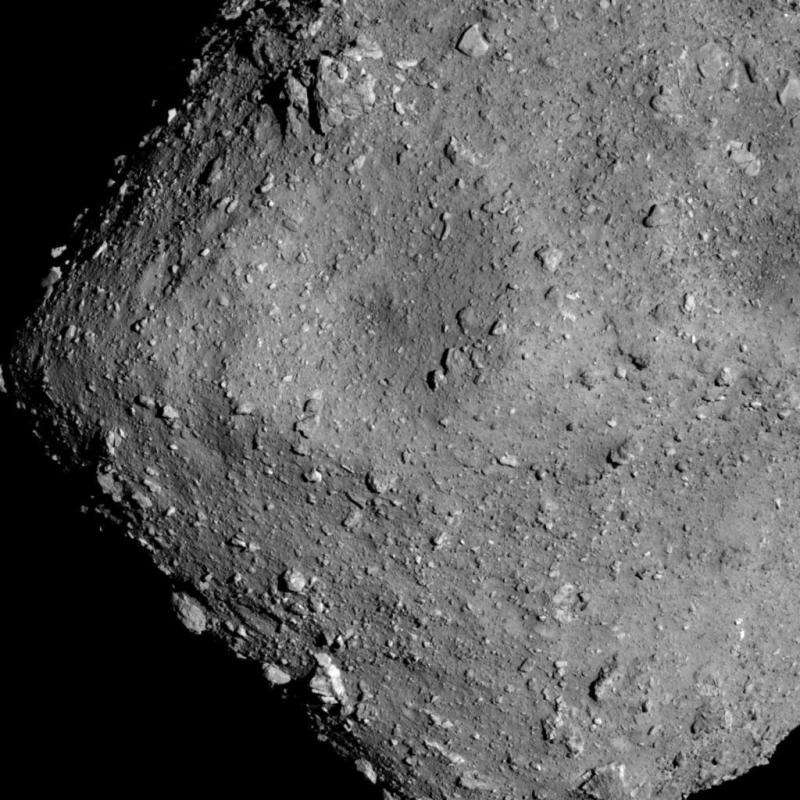
In the image above, asteroid Ryugu is seen from an altitude of 6 km. The image was captured with the Optical Navigation Camera on July 20th, 2018. Image credit: JAXA, University of Tokyo, Kochi University, Rikkyo University, Nagoya University; Chiba Institute of Technology, Meiji University, University of Aizu, AIST.