
Minerals and rocks are metamorphosed by the passage of shock waves generated during impacts from asteroids or comets at cosmic speeds (typically between five and several tens of kilometers per second). Minerals in particular exhibit characteristic, irreversible effects known as shock effects. These include phenomena such as deformation, phase transitions, decomposition, amorphization in the solid state, melting, and vaporization, and are important criteria for detecting impact craters and determining the pressure of shock-affected (“shocked”) minerals. The combination of shock effects of different minerals is used to classify impact-metamorphosed rocks, meteorites, and sample material collected during space missions.
In this field, naturally shocked minerals and rocks from terrestrial impact craters and meteorites are examined. Additionally controlled impact experiments are carried out to generate shock effects in a variety of materials. The shock wave effects are characterized using microanalytical methods (optical microscopy, electron microscopy, Raman spectroscopy, transmission electron microscopy) to understand the formation mechanisms of shock effects in different materials, improve their pressure calibration, and thus further develop the shock wave metamorphism classification of rocks and meteorites.
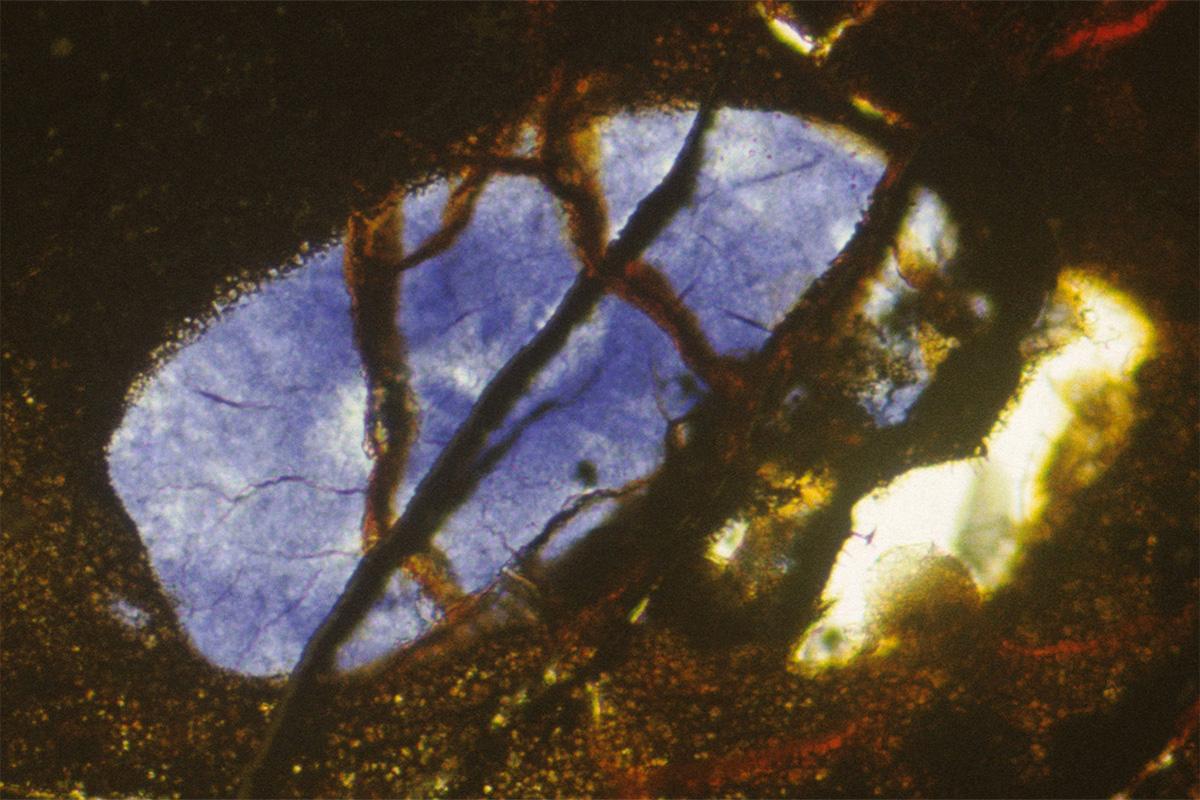
The image show ringwoodite, a high-pressure phase of the silicate olivine.