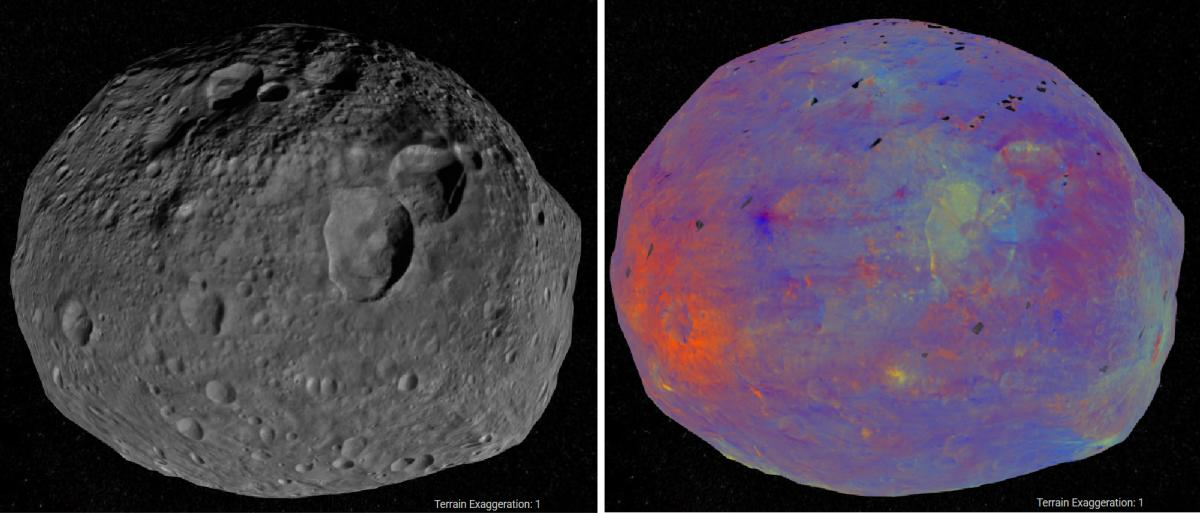
In this interdisciplinary project funded by the German Research Foundation, we try to understand how endogenic mafic material on differentiated planetary surfaces interacts with exogenic volatile-bearing material during or after an impact event. In doing so, the disciplines general geology, remote sensing and mineralogy/geochemistry are combined. This project focusses on the question whether mineralogical changes can occur within mafic minerals while interacting with volatiles, and what kind of influence this might have on the reflectance spectra of planetary surfaces.
The mineralogical changes could be provoked by free volatile species, which may occur as the result of previously bound volatiles being released during an impact event due to temperature and pressure increase. In the course of this project, we will transmit the results of already existing observations and laboratory experiments regarding the asteroid (4) Vesta (upper image) to Mars and the Moon as well as conduct continuative mineralogical experiments and analysis.
Vesta possesses numerous ejecta deposits that exhibit morphologies indicating devolatilization (Denevi et al. 2012). These morphologies show distinct spectral properties (Michalik et al. 2021), the causes of which are still uncertain. The pyroxene-dominated reflectance spectra of the surfaces of these devolatilization morphologies are characterized by higher overall reflectances, more pronounced mafic absorption bands and lower OH abundances with respect to the adjacent material of the same ejecta deposit. The spectral differences of both of these surfaces are not consistent with variations in grain size, roughness, age or shock state. A current hypothesis suggests changes in the occupation of the M1 and M2 cation sites within the pyroxene crystals or the migration of iron cations within the crystal as the cause of the different spectral properties (Cutler et al. 2020). By means of scanning electron microscopy (SEM), transmission electron microscopy (TEM), Mössbauer spectroscopy and electron microprobe analysis (EMPA) (in our laboratories and in cooperation with other laboratories), we will test this hypothesis on already existing and new analog samples.
Moreover, this project aims at increasing the number of planetary objects being investigated. Widespread devolatilization morphologies on Mars are geologically and morphologically very similar to those on Vesta (Tornabene et al. 2012), yet have not been spectrally characterized nor spectrally compared to the Vestan morphologies. Such study could draw a more comprehensive picture of these morphologies and possibly help elucidate the causes for the spectral distinctness on Vesta. In addition, we will reconsider the so-called lunar swirls (e.g., Kramer et al. 2011, Blewett et al. 2021) in the light of the abovementioned hypothesis. The lunar swirls exhibit very similar spectral properties as the devolatilization morphologies on Vesta, yet they have not been scientifically connected. The currently most acknowledged theory involves local magnetic fields that partly shield the area of lunar swirls from the solar wind (e.g. Glotch et al. 2015). With selective spectral analyses and new experiments, we intend to clarify whether an interaction with volatiles might also be able to cause these phenomena (Syal & Schultz 2015). Last but not least, we aim at re-evaluating the spectral properties of the “Orange Material” on Vesta (Le Corre et al. 2013) and investigate whether the steep visible slope in reflectance could also be caused by volatile interaction.
This work is supported by the Walter Benjamin Programme of the German Research Foundation under the project number 528399203.
Description of above image: Asteroid 4 Vesta as seen from NASA’s Dawn spacecraft. Left: Surface mosaic created from Dawn Framing Camera High Altitude and Low Altitude Mapping Orbits (HAMO & LAMO). Right: Dawn Framing Camera “Mineral Ratio” in HAMO resolution with the following composite: R = 750/428 [nm], G = 750/917 [nm], B = 428/750 [nm]. This mineral ratio emphasizes light absorptions of the surface around 950 nm in greenish colors as well as reflectance variations between red and blue wavelengths. Both images were extracted from NASA’s Vesta Trek. More information about image processing in Roatsch et al. 2012 & 2013. Image credit: NASA/JPL-Caltech/UCLA/MPS/DLR/IDA