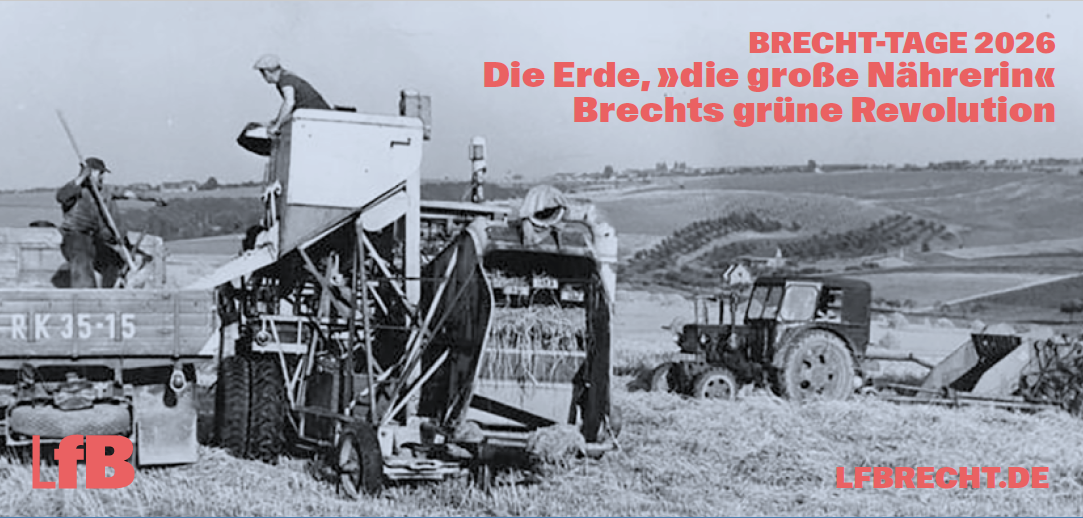
Brecht-Tage 2026 - Die Erde, »die große Nährerin«. Brechts grüne Revolution
These three events will take place at the museum as part of the Brecht-Tage 2026:
A Plan to Save the Future from Collaps: Half Earth Socialism
Troy Vettese in conversation with Dirk Baecker and Maike Weißpflug (in english)
An important legacy of naturalist E.O. Wilson is his book "Half-Earth". In it, he calls on us to leave half of the Earth to nature. Troy Vettese & Drew Pendergrass take up this call with HALF EARTH SOCIALISM. For them, the only alternative to renaturation is gigantic geoengineering programmes. To illustrate the danger of such domination of nature, they read the classics of neoliberal literature against the grain. Hayek's thesis of ‘agnotology’ or unknowability is turned on its head: it is not markets but ecosystems that are too complex to be regulated. Can this idea be the basis for ecological politics in times of impending collapse?
On the podium:
- Troy Vettese
- Maike Weißpflug
- Dirk Baecker
- Moderator: Alexander Karschnia
The event will be held in English!
When: Wednesday, 11 February 2026, 5-6 p.m.
You can register for this event here
On the use and abuse of changing models
Panel discussion with Drew Pendergrass, Sebastian Kirsch, Tom Turnball and Patrick Primavesi (in English)
Brecht's fondness for ‘models’ may not be widely known, but it is clearly evident in his contribution to „Theater des wissenschaftlichen Zeitalters“(The Theatre of the Scientific Age). Walter Benjamin summed up Brecht's attitude in a single sentence: „Es kann so kommen, aber es kann auch ganz anders kommen; das ist die Grundhaltung eines Menschen, der für das epische Theater schreibt“(It may happen this way, but it may also happen quite differently; that is the basic attitude of a person who writes for epic theatre) – a formulation that comes incredibly close to the logic of contemporary scenario thinking. In climate research in particular, and in the geosciences in general, models are an integral part of the ‘theatre of science’. Thinking in ‘scenarios’, as practised by the IPCC and other climate organisations, was explored much earlier in Renaissance theatre, at a time when Galileo had to hide his knowledge about the sun. A further development of Brecht's model concept could start where he himself recommended changing his models while he was formulating them.
On the podium:
- Drew Pendergrass
- Sebastian Kirsch
- Tom Turnball
- Patrick Primavesi
- Moderator: Maike Weißpflug
The event will be held in English!
When: Wednesday, 11 February 2026, 6:30–7:30 p.m.
You can register for this event here
From Cultures of Fear to Ecologies of Hope
Lecture by Jason Moore followed by a discussion with Carla Reemtsma (in English)
Marx discovered two sources of all wealth: the earth (nature) and the worker (labour). For a long time, the latter was the focus of the labour movement. In recent years, attention has shifted to the former, or rather to the relationship between the two. With his approach to ‘world ecology,’ Jason Moore is one of the most important representatives of this new generation of eco-Marxists. Instead of the Anthropocene, he prefers to speak of the ‘Capitalocene.’ We can only reorganise our ‘metabolism with nature’ if we no longer view society and nature as two separate domains, but as interconnected in a ‘web of life’. But how do we get from rollback and inevitable climate catastrophe to socialism in the web of life, from cultures of fear to ecologies of hope?
When: Wednesday, 11 February 2026, 8–10 p.m. – Followed by a reception in the museum's dinosaur hall