
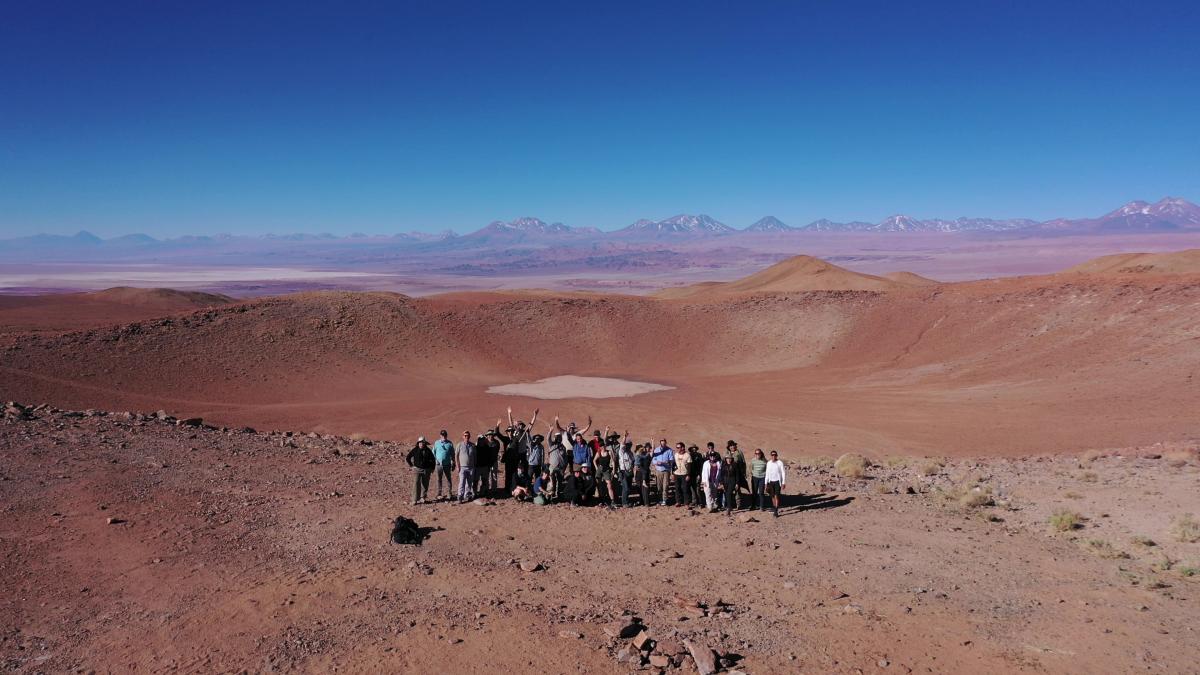
The Monturaqui impact crater (MIC) is one of ~200 impact craters known on Earth and the only known impact structure in Chile. It is located at the foothills of the Andean Mountains. The MIC is an ideal study site for multiple research activities in our subdivision because of the crater’s unique characteristics, e.g., medium size (350 x 370 m), high elevation (3 km), high preservation due to the desert environment, and the fairly young age of ~663 thousand years, and the fact that an iron bolide struck a largely granitic target rock.
These and other aspects make the MIC an ideal natural laboratory for studying some of our central research topics such as: (1) Impact physics of small crater formation processes; (2) Petrography of impactites and reconstruction of impactor–target interaction; (3) Ablation and impact spherules through time and space; and (4) Impact-induced habitability changes and its implications.
For deepening our understanding of the MIC and expanding our multidisciplinary research approach we organized a 10-day workshop and field work campaign in Chile that was largely funded by a DFG grant ‘Initiation of an International Cooperation’. Among the roughly 30 participants, 14 researchers and students were from the MfN, while most of the others were Chilean scientists. The combination of seminar sessions and field work at the crater yielded the anticipated results of gathering samples and field data for pilot projects, initiating interdisciplinary and internationalcollaborations, and enabling us to generate promising research proposals.
Image credit: Dr. Christoph Sager, Museum für Naturkunde