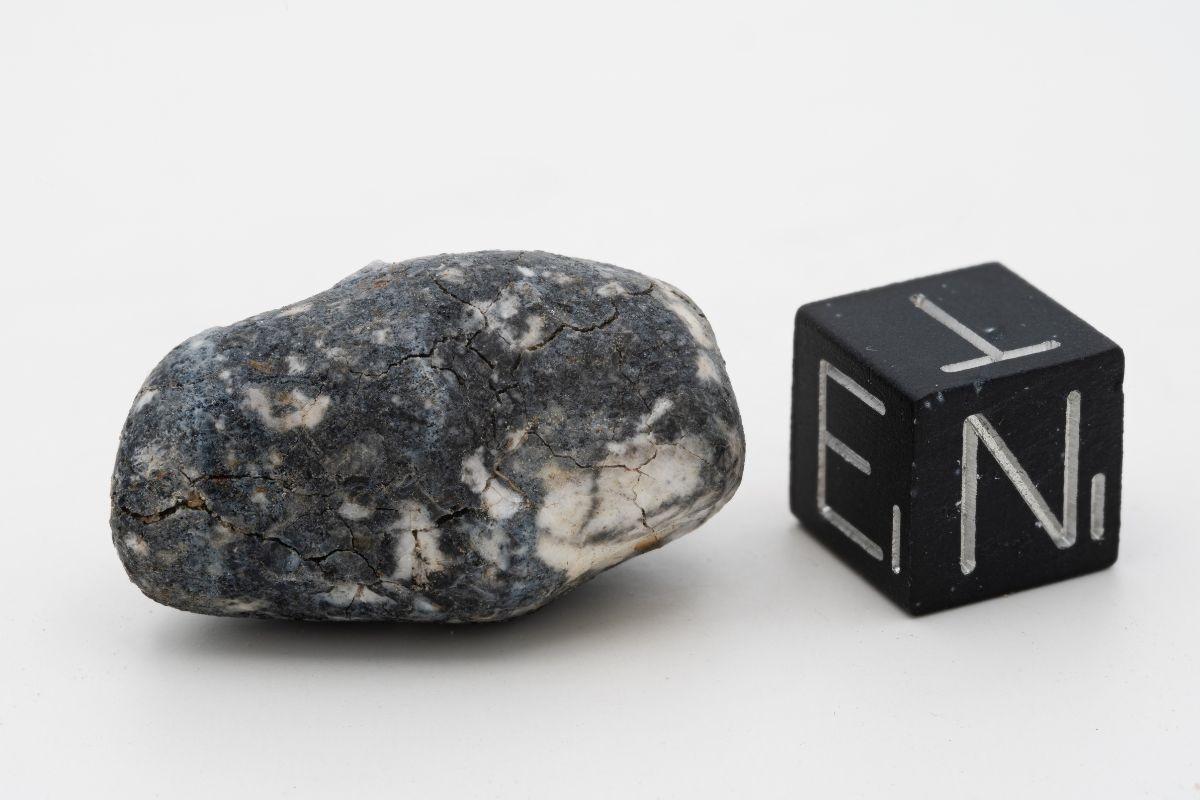
On January 20, 2024 late in the evening the Hungarian astronomer Krisztián Sárneczky discovered an only 40 cm sized bright asteroid (2024 BX1) on collision course with Earth using a telescope at Konkoly Observatory. NASA’s Scout and ESA’s Meerkat asteroid guard systems calculated an impact on Sunday, January 21 at 1:33 a.m. passing over the village of Nennhausen, about 60 km west of Berlin. Exactly at the predicted time a bright fireball was observed over the region and ALLSKY images documented the brake-up of the bolide into numerous pieces. An immediate search for meteorite fragments conducted by a team of scientist from the Museum für Naturkunde and the German Aerospace Center (DLR) on the same day remained unsuccessful. Following calculations taking the strong winds into account that blew during the fall placed the strewn field further east stretching over the village of Ribbeck and it was exactly there where the first meteorite was found by Polish meteorite hunters after four days of intense searching.
Worldwide, this is only for the fourth time that an asteroid has been observed in space, during atmospheric entry and finally sampled as meteorites on Earth. Comparing the fragment with type specimen in the Museum’s meteorite collection revealed that it belongs to the very rare class of Aubrites (after the village of Aubres, France where the first meteorite of this type fell in 1836). Aubrites make up just 0.01 percent of all meteorite falls and are of high scientific interest as they contain valuable information on early planet formation in the Solar System. For classification, small slices of the newly found meteorite were immediately studied using the Museum’s (FB1) laboratory infrastructure including electron microprobe, micro-X-ray fluorescence, and computer tomography. Only two weeks after submission the meteorite was officially accepted by the Meteoritical Society as an aubrite and named Ribbeck.
Searching the about eight-kilometre-long and 400-meter-wide strewn field the Museum-DLR team supported by colleagues and students from the Freie and the Technische Berlin and the SETI (Search for Extraterrestrial Intelligence) Institute recovered 25 meteorite fragments with a total mass of about 160 grams. The meteorite fall received a broad media coverage and museum scientists gave numerous interviews for local, national and international newspapers, science and popular science magazines, social media channels, and TV stations. The find story was also covered by Pro 7 in the Galileo TV series. The Ribbeck pieces collected by museum scientist and students became part of the Museum’s meteorite collection and the most impressive pieces are presented to the public in a special museum exhibition.
As a fresh fall of a very rare meteorite class, Ribbeck became also target of intensive scientific studies. Led by museum, DLR and SETI researchers a consortium of almost hundred international experts is currently conducting, e.g., chemical, mineralogical, and spectroscopic studies using state-of-the-art methods ultimately leading to publications in renown science journals. The Ribbeck meteorite fall attracted many professional and amateur meteorite hunters and over the course of about eight weeks a total of 203 fragments weighing about 1.8 kilograms were reported. The fall also gives raise to improve methods for early warning of objects from space. Especially large objects that are close to Earth, so called NEOs (Near Earth Objects) have the potential to cause severe damage when impacting on Earth. Scientists from the museum are involved in ESA's HERA space mission to evaluate possible mechanism of deflecting dangerous asteroids by collisions with space probes. The Ribbeck fall shows that we should be prepared for such scenarios.
photo: MfN Ribbeck meteorite, L. Kranich

