
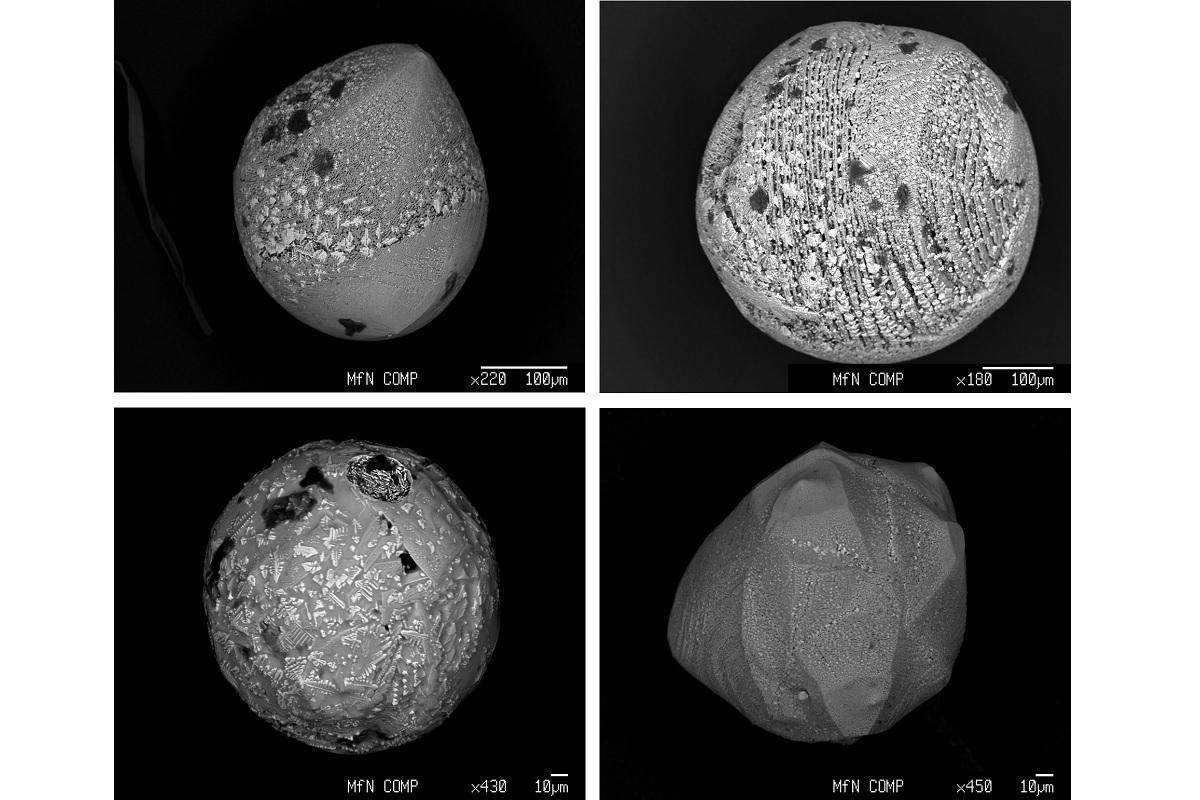
Besides large asteroid impacts, micrometeorites represent the largest amount of extra-terrestrial material that has continuously reached our planet throughout Earth's history. Approximately 40,000 tons of extra-terrestrial material enter our atmosphere each year. Of this, about 1,600 tons per year land on our surface as micrometeorites; the remainder likely vaporizes.
Research into the origin and formation of micrometeorites has been established at the MfN since 2019. This includes investigations of micrometeorites from Antarctica, ancient sediments, and urban rooftops. Laser experiments are also conducted to simulate the melting process during atmospheric entry under controlled conditions.
The aim of these investigations is to better understand the origin of micrometeorites, related cosmic events, and the role of atmospheric entry in the formation of different micrometeorite species (Suttle et al. 2021, Van Maldeghem et al. 2023, Feige et al. 2024, Krämer Ruggiu et al. 2025). Preliminary laser experiments show that a wide variety of spheroids corresponding to known micrometeorite species can be produced from a single chondrite sample.
Research on urban micrometeorites is also considered an ideal approach for citizen science (Hecht et al. 2021, Suttle et al. 2021, Hasse 2025). In close collaboration with the education and public relations team of Department FB3, several projects were carried out with Berlin citizens, and in particular, collaborations with Berlin secondary schools. Even short citizen science projects on micrometeorites at secondary schools can significantly improve the understanding of natural sciences and geoscientific literacy (Moormann et al. accepted).
Publications:
Feige, J., Airo, A., Berger, D., Brückner, D., Gärtner, A., Genge, M., Leya, I., Habibi Marekani, F., Hecht, L., Klingner, N., Lachner, J., Li, X., Merchel, S., Nissen, J., Patzer, A. B. C., Peterson, S., Schropp. A., Sager, C., Suttle, M.D., Trappitsch, R. & Weinhold, J. (2024). Transport of dust across the Solar System: Constraints on the spatial origin of individual micrometeorites from cosmic-ray exposure. Phil. Trans. R. Soc. A 382: 20230197. https://doi.org/10.1098/rsta.2023.0197.
Hasse, T. (2025): Urbane Mikrometeorite: erkennen und unterscheiden. Amazone KDP, 218 pp., https://amzn.eu/d/0ejjdpp2.
Hecht, L., Milke, R., & Greshake, A. (2021). Urbane Mikrometeorite: Citizen Science in den Geowissenschaften. In ARGE GMIT (Ed.), Geowissenschaftliche Mitteilungen, – GMIT 84,(S. 8–21). ARGE GMIT. https://doi.org/10.23689/fidgeo-4328.
Krämer Ruggiu, L.; Villeneuve, J.; Da Silva, A. C.; Debaille, V.; Decrée, S.; Hecht, L.; Kaufmann, F.E.D.; & Goderis, S. (2025). Diversity among Fossil Micrometeorites in the Late Devonian. Geochimica et Cosmochimica Acta, 405, 114–31. https://doi:10.1016/j.gca.2025.07.016.
van Maldeghem, F., van Ginneken, M., Soens, B., Kaufmann, F., Lampe, S., Kramer, R. L., Hecht, L., Claeys, P. & Goderis, S. (2023). Geochemical Characterization of Scoriaceous and Unmelted Micrometeorites from the Sør Rondane Mountains, East Antarctica: Links to Chondritic Parent Bodies and the Effects of Alteration. Geochimica et Cosmochimica Acta 354: 88–108. https://doi.org/10.1016/j. gca.2023.06.002.
Moormann, A., Tilove, A., Dieter, D., Miedtank, A. and Hecht, L. (2026): Science Beyond School: Exploring Students’ Understanding of Science Through a Citizen Science Project on Micrometeorites. Education Sciences. https://doi.org/10.3390/educsci16020291
Suttle, M.D., Hasse, T. & Hecht, L. (2021): Evaluating urban micrometeorites as a research resource—A large population collected from a single rooftop. Meteoritics & Planetary Science, https://doi.org/10.1111/maps.13712.