Impacts of cosmic bodies (asteroids, comets) can have catastrophic consequences on Earth. Fortunately, large asteroids, which devastate entire landscapes or continents when impacting on Earth, are rather infrequent, they are mostly known, or can be detected long before the actual impact. However, the record of smaller asteroids (<200 m) and meteoroids is incomplete simply because of their large number, and because they are more difficult to detect as they tend to be much fainter. The numerous so-called NEOs (Near-Earth-Objects), which are on Earth-crossing orbits, pose a serious hazard. A well-known example of such an event is the Chelyabinsk meteor that burst in the atmosphere in the morning of the 15th of February 2013 above the Russian city Chelyabinsk. The blast wave generated by the airburst caused severe damage.
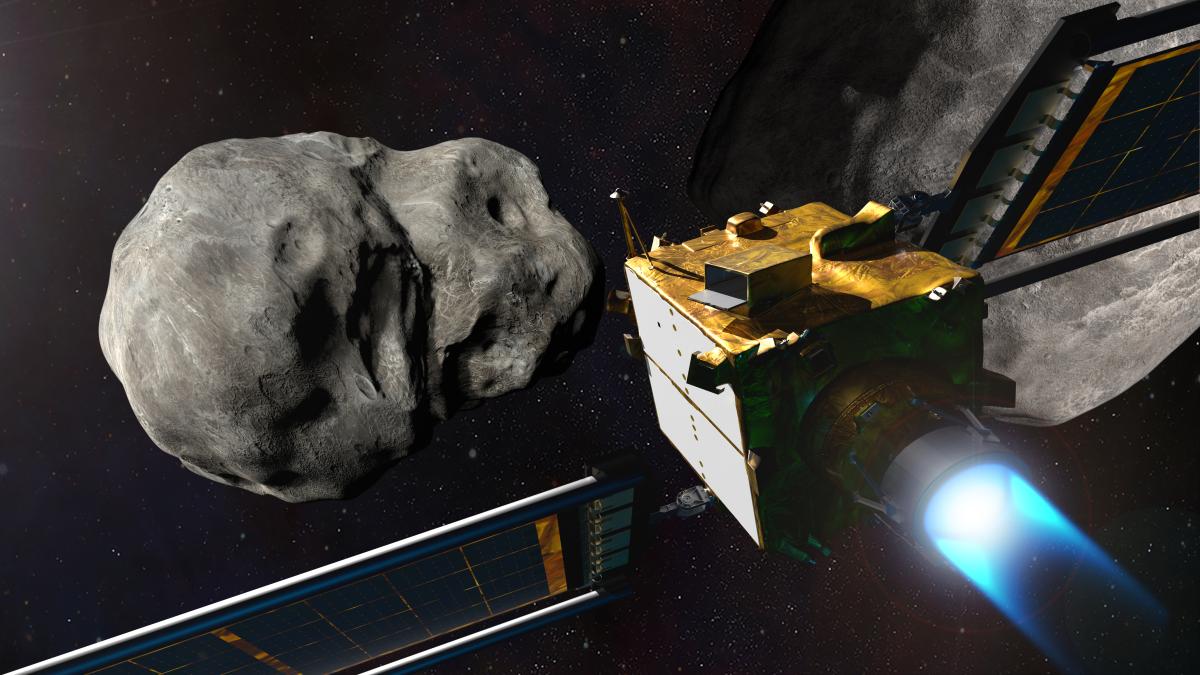
If an asteroid on a collision course with Earth is too large and its impact must be prevented, a so-called kinetic impactor currently represents the most practical defense strategy. This involves deliberately causing a collision with a spacecraft to deflect the asteroid from its trajectory. Such a kinetic impactor was tested as part of the DART (NASA, impactor) and Hera (ESA, observation system for characterising the asteroid system and the impact's effects) missions. The Museum für Naturkunde Berlin is involved in both missions.
The following projects are or have been conducted at the Museum für Naturkunde in the field of planetary defence:
- Deflection of asteroids – DART & Hera
The goal of the missions, led by NASA and ESA, is to provide scientific evidence for the possibility of deflection of an asteroid by external impact. The Museum für Naturkunde Berlin is part of the international team. - Effects of meteorite impacts
If a cosmic object is threatening to impact Earth fast predictions of the consequences will be provided by the usage of a database containing numerous pre-processed models of likely impact scenarios. In this project, a software to predict the impact effects was developed for ESA. - Impact risk for lunar infrastructure
Direct impacts and material ejected from craters pose a risk for lunar infrastructure. In this project, we analyse this risk and the damage levels for key infrastructures.